
Description
PrymaLab · Research Use Only
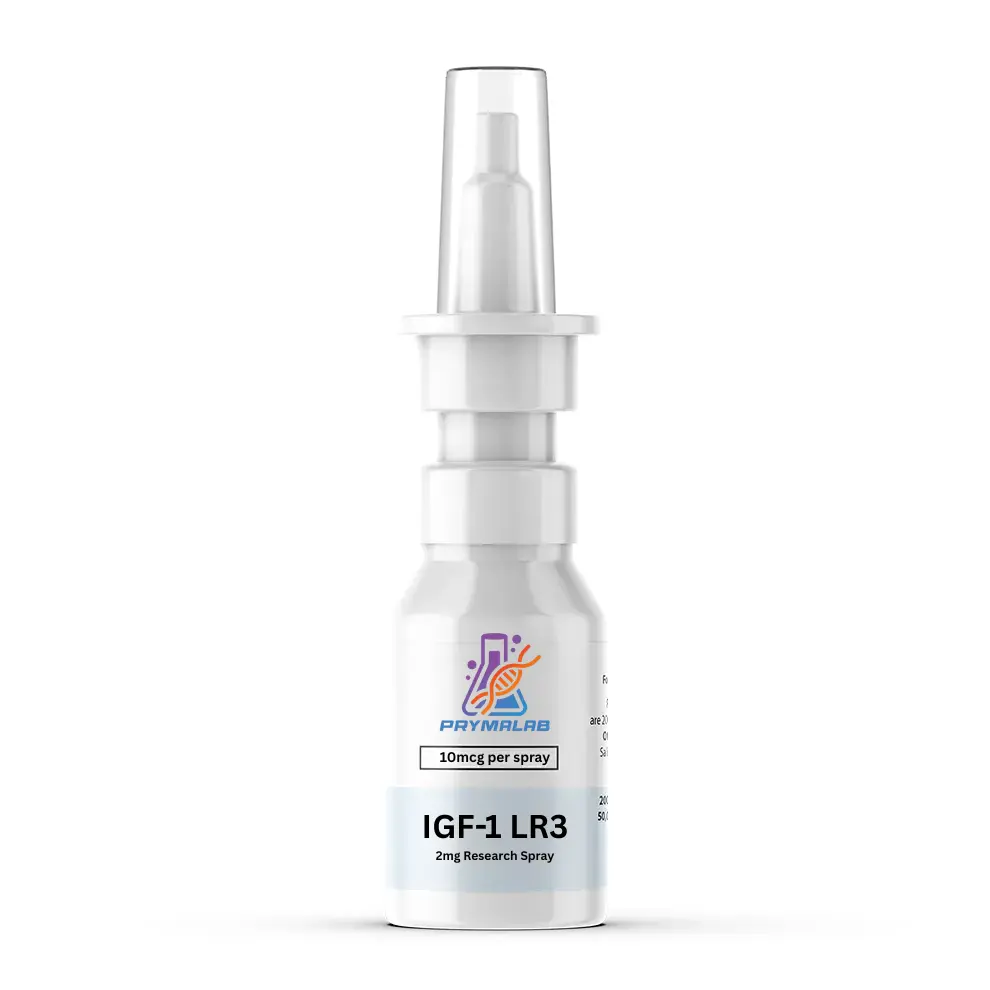
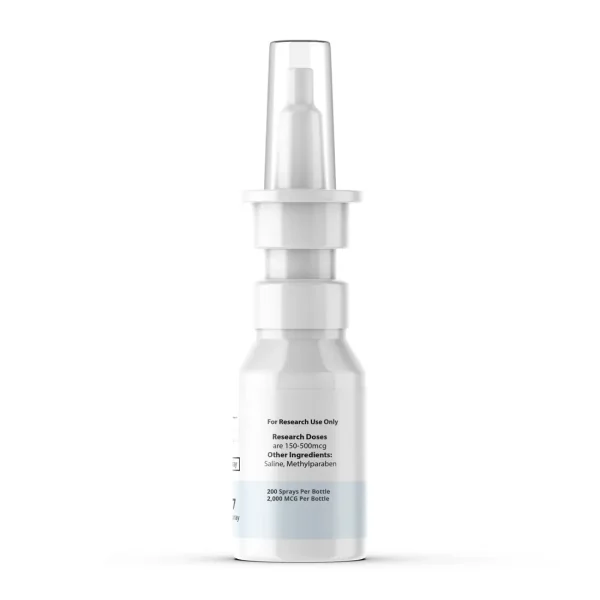
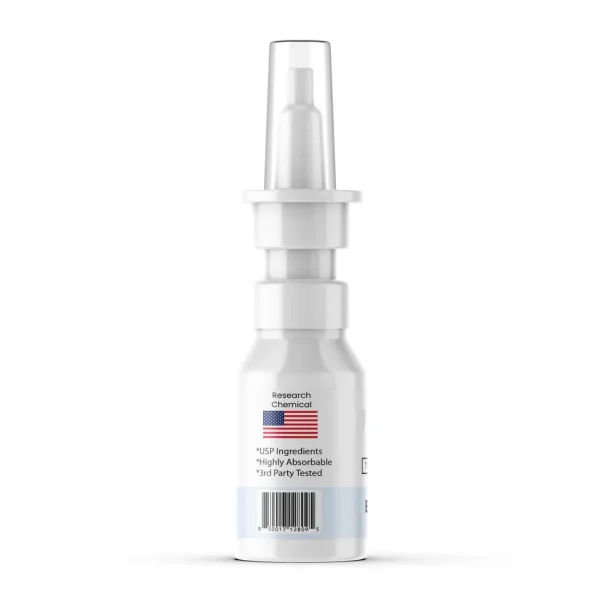
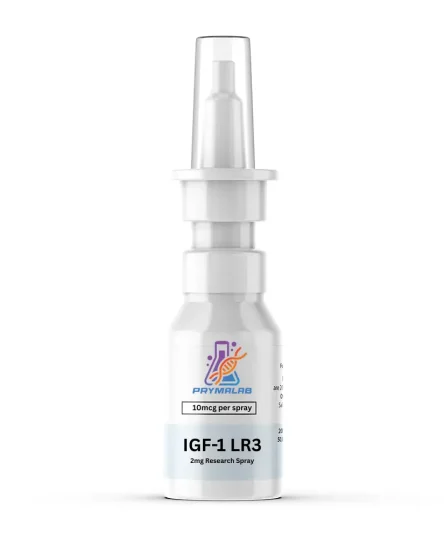
IGF-1 LR3 Nasal Spray
83-residue analogue · approximately 9,111 Da
IGF-1 LR3 nasal spray supplies the 83-residue Long R3 analogue of insulin-like growth factor 1 as a metered aqueous solution. At roughly 9,111 daltons this is not a peptide in the sense the rest of this range are peptides. It is a folded protein, and that distinction governs everything about the format.
Specification Table
| Property | Value |
|---|---|
| Compound | Long R3 IGF-1 |
| Residue count | 83 |
| Molecular weight | Approximately 9,111 g/mol. Confirm against the lot certificate |
| Parent molecule | Human insulin-like growth factor 1, 70 residues |
| Modification 1 | Arginine substituted for glutamate at position 3 |
| Modification 2 | A 13-residue extension added at the amino terminus |
| Purpose of the Arg3 substitution in published work | Reduced affinity for IGF binding proteins |
| Structural class | Folded protein with internal disulfide bonds, not a linear peptide |
| Higher-order structure | Present. Activity depends on correct folding, not sequence alone |
| Chromophore | Aromatic residues present. 280 nm absorbance applies for total protein |
| Size relative to this spray range | Roughly seven times the mass of the next largest compound here |
| Format | Metered nasal spray, solution state |
| Physical state | Aqueous solution, supplied ready to use |
| Purity | Per lot-specific certificate of analysis |
| Storage | 2-8°C, protected from light. Do not freeze |
| Regulatory status | No approved human or veterinary formulation in any jurisdiction |
Why Does Size Dominate the IGF-1 LR3 Nasal Spray Question?
This page has to lead with a limitation rather than a feature, because the limitation is the most important fact about the format.
Molecular weight is the strongest single predictor of transnasal transport, and published work shows a steep decline as size rises.
The practical transition sits around 1,000 daltons, where paracellular passage between epithelial cells becomes inefficient. Above a few thousand daltons, transport by that route is negligible.
At roughly 9,111 daltons this molecule is nine times the transition weight and roughly seven times the mass of the next largest compound in this spray range.
Reported nasal bioavailability for proteins in this size class is generally well under one percent without an absorption enhancer, and the variance between applications is wide.
Saying so directly is more useful than implying otherwise. Anyone planning quantitative work by this route should measure what is delivered rather than assume it from the metered volume.
That is not an argument against the format. It is an argument for treating delivered amount as an unknown, and for designing experiments that can tolerate a small and variable delivered fraction.
Where a defined systemic exposure is required, the published literature on this molecule used parenteral routes and that is what the figures in it describe.
What Do the Two Modifications Do?
The name encodes both changes, and each was made for a documented reason.
The R3 part refers to arginine replacing glutamate at position three of the mature IGF-1 sequence.
That substitution reduces affinity for the IGF binding proteins, a family of carrier proteins that sequester circulating IGF-1 and limit how much is free to engage the receptor.
The Long part refers to a 13-residue extension added at the amino terminus, which lengthens the molecule from 70 residues to 83 and further reduces binding-protein association.
Together the two changes produce an analogue that stays free in solution and in circulation far longer than the native protein does.
That is the entire design rationale, and it is a pharmacokinetic argument rather than a potency argument. Receptor affinity itself is not the property being altered.
For an experiment, the consequence is that this analogue and native IGF-1 are not interchangeable, and a result obtained with one does not transfer to the other without argument.
One further consequence of the extension deserves stating, since it affects how the analogue is quantified rather than how it behaves.
Thirteen extra residues change the extinction coefficient, so a concentration calculated using the native IGF-1 value will be wrong.
The correct coefficient is computed from this sequence rather than borrowed from the parent, and the difference is large enough to matter wherever a published concentration series is being reproduced.
It also shifts the isoelectric point, which changes chromatographic retention and adsorption behaviour relative to native IGF-1.
Why Is Folding the Real Verification Question?
For a linear peptide, sequence and mass are close to sufficient. For a folded protein they are not, and this is where certificates in this market are weakest.
This molecule contains internal disulfide bonds and adopts a defined three-dimensional structure. Receptor engagement depends on that structure rather than on the sequence alone.
A preparation with the correct sequence, the correct mass and the wrong disulfide pairing is a different molecule functionally while passing every routine test.
Mass spectrometry sees the correct mass because scrambled disulfides are isomers of the properly folded form. The atoms are identical and only the connectivity differs.
Reversed-phase chromatography can sometimes separate misfolded from correctly folded material, but the method has to be developed for it and a generic gradient will not.
Three methods answer it. Circular dichroism reports secondary structure content. Size exclusion chromatography reports aggregation state, and a functional receptor assay reports whether the protein actually works.
Almost no supplier in this market runs any of them, and asking which were run is the single most informative certificate question for this compound.
A purity figure above 98 percent by chromatography tells you about chemical homogeneity and nothing at all about whether the protein is folded correctly.
What Does Solution State Mean for a Protein?
The format question is sharper for a folded protein than for any peptide in this range. It goes in one direction.
Lyophilized protein is comparatively stable. Structure is locked in the solid state and the degradation routes that need water are unavailable.
A protein in aqueous solution is subject to aggregation, surface adsorption, disulfide scrambling and slow unfolding, all of which proceed at rates that depend on concentration and temperature.
Aggregation is the most consequential of those. Protein molecules that associate into dimers and higher oligomers are removed from the active pool, and the process is often irreversible.
Aggregates are invisible to mass spectrometry of the monomer and to a purity chromatogram run under denaturing conditions. Size exclusion chromatography is the method that sees them.
Surface adsorption matters at the low concentrations typical of a spray, since a protein lost to the container wall never reaches the nozzle.
Freeze-thaw is particularly damaging for proteins because ice formation concentrates solute and creates an air-water interface, both of which drive aggregation. Never freeze this product.
The honest summary is that a lyophilized vial is the more defensible format for a molecule of this size, and the spray trades some of that stability for delivery convenience.
How Does This Compare With IGF-1 DES?
Two IGF analogues appear in this spray range and the distinction between them is structural rather than nominal.
This compound is longer than native IGF-1, at 83 residues against 70, because of the amino-terminal extension.
IGF-1 DES is shorter, at 67 residues, because its first three residues have been removed.
Both modifications aim at the same target, which is reduced association with IGF binding proteins, and both approach it by altering the amino-terminal region that those proteins recognise.
One does it by adding bulk and one by deleting the recognition site, which is an instructive pair for anyone studying how that interaction works.
The mass difference is substantial, roughly 9,111 against roughly 7,371. So the two are trivially distinguished by mass spectrometry and no supplier should confuse them.
For an experiment they are separate compounds with separate published records, and citing work on one to support a claim about the other requires an explicit argument.
What Concentration Question Applies to a Protein Spray?
Quantifying protein in solution raises a problem the small peptides in this range never present. It is worth understanding before trusting a label.
Aromatic residues give this molecule a genuine chromophore, so absorbance at 280 nanometres provides a concentration estimate against the extinction coefficient calculated from sequence.
That measurement reports total protein regardless of folding state, so it counts correctly folded monomer, misfolded monomer and soluble aggregate as the same thing.
A bottle can therefore read at the labelled concentration while containing a substantially reduced amount of functional material.
Light scattering from aggregates also inflates apparent absorbance at 280 nanometres, which pushes the reading upward as the preparation degrades.
Correcting for scatter by subtracting a baseline reading at 320 nanometres, where the protein does not absorb, is a standard adjustment and it is rarely applied outside formulation laboratories.
The combination means that a concentration figure on a protein spray label carries less information than the same figure on a small peptide product.
Size exclusion chromatography reporting monomer percentage alongside the concentration is what would make the number meaningful, and it is worth requesting.
How Should the Spray Be Stored and Recorded?
Storage for a folded protein in solution is more demanding than for any peptide in this range.
Keep the bottle in the dark between 2 and 8 degrees Celsius. Never freeze it, because freeze-thaw drives aggregation in a way that has no equivalent among the small peptides in this range.
Avoid agitation. Shaking creates an air-water interface where proteins unfold and aggregate, so a bottle should be inverted gently rather than shaken.
Minimise the number of times the bottle is opened, since each opening admits air and introduces a fresh interface.
Inspect the solution before use. Visible haze or particulate indicates aggregation has progressed to the point where the material is no longer suitable for quantitative work.
Absence of visible haze does not mean absence of aggregation, since soluble oligomers are invisible to the eye and require size exclusion chromatography to detect.
Log the lot, the stated concentration, the opening date, the storage temperature, how the solution looked at each use, and how many actuations were drawn.
For a protein at this size, time in solution and thermal history are the two variables that most determine whether a result is reproducible.
Published Literature
Selected references verified against the publisher record.
- (‘Francis GL, Ross M, Ballard FJ, et al. Novel recombinant fusion protein analogues of insulin-like growth factor (IGF)-I indicate the relative importance of IGF-binding protein and receptor binding for enhanced biological potency. J Mol Endocrinol. 1992;8(3):213-223.’, ‘https://doi.org/10.1677/jme.0.0080213’)
- (‘Tomas FM, Knowles SE, Owens PC, et al. Effects of full-length and truncated insulin-like growth factor-I on nitrogen balance and muscle protein metabolism. J Endocrinol. 1991;128(1):97-105.’, ‘https://doi.org/10.1677/joe.0.1280097’)
- (‘Illum L. Nasal drug delivery: new developments and strategies. Drug Discov Today. 2002;7(23):1184-1189.’, ‘https://doi.org/10.1016/S1359-6446(02)02529-1’)
- (‘Manning MC, Chou DK, Murphy BM, et al. Stability of protein pharmaceuticals: an update. Pharm Res. 2010;27(4):544-575.’, ‘https://doi.org/10.1007/s11095-009-0045-6’)
Frequently Asked Questions
What is IGF-1 LR3 nasal spray?
A metered aqueous solution of the 83-residue Long R3 analogue of insulin-like growth factor 1, roughly 9,111 daltons. Sold for laboratory research only, and approved in no jurisdiction for any purpose.
Why does size dominate the format question?
Because nasal transport declines steeply with molecular weight, with the practical transition around 1,000 daltons. At roughly 9,111 this molecule is nine times that weight and seven times the next largest compound here.
What bioavailability should be expected?
Reported nasal bioavailability for proteins in this size class is generally well under one percent without an absorption enhancer, with wide variance between applications. Delivered amount should be measured rather than assumed.
What does the R3 modification do?
Arginine replaces glutamate at position three, reducing affinity for the IGF binding proteins that sequester circulating IGF-1 and limit how much is free to engage the receptor.
What does the Long modification do?
A 13-residue extension at the amino terminus lengthens the molecule from 70 residues to 83 and further reduces binding-protein association. Both changes are pharmacokinetic rather than potency modifications.
Why is folding the real verification question?
Because this molecule has internal disulfide bonds and a defined three-dimensional structure. A preparation with correct sequence, correct mass and wrong disulfide pairing passes every routine test while being functionally different.
Can mass spectrometry detect misfolding?
No. Scrambled disulfides are isomers of the correctly folded form, so the atoms are identical and only the connectivity differs. The mass is the same.
What methods do answer it?
Circular dichroism for secondary structure, size exclusion chromatography for aggregation state, and a functional receptor assay. Almost no supplier in this market runs any of them.
What happens to a protein in solution?
Aggregation, surface adsorption, disulfide scrambling and slow unfolding, at rates depending on concentration and temperature. Aggregation is the most consequential and is often irreversible.
Why must it never be frozen?
Because ice formation concentrates solute and creates an air-water interface, both of which drive aggregation. Freeze-thaw damages proteins in a way that has no equivalent among the small peptides in this range.
How does it differ from IGF-1 DES?
This compound is longer than native IGF-1 at 83 residues; IGF-1 DES is shorter at 67. Both target reduced binding-protein association, one by adding bulk and one by deleting the recognition site.
Compliance Statement
IGF-1 LR3 nasal spray is sold exclusively for laboratory research use. It is not a drug, food, or cosmetic product, and it is not a dietary product of any kind. It is not approved by the FDA or any comparable authority for human or veterinary use, no approved formulation exists in any jurisdiction, nasal bioavailability for a protein of this size is generally well under one percent, and the published literature on this molecule used parenteral routes. This product is not intended to diagnose, treat, cure, or prevent any disease. It must not be given to humans or animals. Purchase is restricted to qualified researchers and institutions operating within applicable laws. All handling is the responsibility of the purchasing laboratory.
Other formats of IGF-1 LR3
IGF-1 LR3 is also stocked as IGF1 LR3 1MG, IGF1 LR3 1mg/ml preloaded 3ml pen, IGF-DES 2mg, IGF-DES 1mg/ml preloaded 3ml pen and IGF-1 DES Nasal Spray. Each listing states its own quantity and concentration, and the pen and vial comparison explains what changes between formats.











11 reviews for IGF-1 LR3 Nasal Spray